A Half-Century Old Remembrance
CAREFREE AND CLUELESS
 Fifty years ago today I was a carefree young man who had recently received his induction notice to report for duty in the United States Army the middle of December. It was at the early stages of what would become known as the Viet Nam War - a non-declared military action that eventually took more than 58,000 American lives and caused a rift in this country that lasted for a decade. However, at that time not many people would have anticipated how it ended up. Life was good for me.
A PERFECT MORNING - SHATTERED
 The morning of November 22, 1963 I was cruising toward Santa Monica in my 1957 Chevrolet convertible, top down, on the way to measure a home for carpet for my father's business - a job I'd held off-and-on between semesters in college and, at that time, prior to joining the Army. It was a typical Southern California day - perfect, except I couldn't find any music on my radio. Finally I just stopped pushing buttons and twisting the dial and listened to the palaver that was coming from my dashboard.
THE UNTHINKABLE...
 Then I heard the message - President John Fitzgerald Kennedy had been shot in Dallas, Texas. Soon I realized the traffic around me had gradually begun to slow to well-within the legal limits as people heard the news and began to contemplate what it meant.
A DIFFICULT MOMENT
 Eventually I made my way to the tidy neighborhood in Santa Monica and knocked on the door of the home where I was supposed to measure several rooms. An elderly gentleman - probably about my age now - slowly opened the door. He, and his wife standing with him, had tears in their eyes and I could hear the television commentator in the living room behind them speculating about the events in Dallas that morning with a strained note of urgency in his voice.
GRACE DURING GRIEF
 I offered to reschedule our appointment, recognizing just how distraught they were, but they graciously declined and showed me the rooms to be measured. For the next half-hour or so I went about my job and they sat, holding hands on the couch in the living room, quietly sobbing as the anxious, confused reports continued to spill out of the old black and white television set.
THE FINAL, TRAGIC NEWS
 Finally, just before I finished my work, news came that the president had, indeed, died from an assassin's bullet a few minutes earlier. I wrapped up my duties, wiping tears from my eyes, and offered my condolences to my customers before I left.
A BLUR...
 I don't recall much about my drive back across the Los Angeles basin to my home. My other appointments had been canceled for the day, so I just went home. I do recall wondering what this tragedy meant, for our country and for me, personally. Was it just the beginning of an attack on our country? There was much prattle on the radio and television about that possibility at the time.
APPREHENSION
 I wondered what this event would mean to my enlistment in the Army a few weeks hence. I didn't pay much attention to politics then, but I found myself wondering what kind of president Lyndon Johnson would make, and what kind of a Commander-in-Chief he would be. I later found out.
THE BEGINNING...
 I suspect memories of that day and subsequent events will creep into my mind from time to time today, just as they have ever since that day fifty years ago. Most of us who were alive and beyond the age of ten years old at the time still recall it vividly. Kennedy's murder, and the subsequent assassinations of his brother, Bobby Kennedy, and Martin Luther King, Jr., left scars on this country that are still visible today.
TENSE AND INTENSE TIMES
 Remember, this was a time in our country when we were still tense about the Cuban Missle Crisis a year earlier. Just a few months later three young voting rights activists were murdered in Mississippi and a few days before I was discharged from the Army two years hence, a cross was burned on the lawn of a black sergeant at Fort Rucker, Alabama - my final duty post deep in the armpit of the South. These were not good times in our country.
AMERICA CHANGED FOREVER
 John F. Kennedy's assassination was the beginning of events that changed American society forever, with the advent of the drug culture, riots in large cities across the country and that damnable, divisive Viet Nam War. Four students were killed by skittish National Guardsmen at Kent State University during an anti-war demonstration in 1970. I still contemplate the 10% of the men of my helicopter flight school class who didn't return from Viet Nam. Many members of my generation carry still-festering wounds from that time in their lives.
VIEW THIS CLIP IF YOU WISH
Here's a short, grainy not-quite-six-minute video clip of Walter Cronkite, often described as "the most trusted man in television", delivering the news of Kennedy's death. It was a sad day for this country...
Fifty years ago today I was a carefree young man who had recently received his induction notice to report for duty in the United States Army the middle of December. It was at the early stages of what would become known as the Viet Nam War - a non-declared military action that eventually took more than 58,000 American lives and caused a rift in this country that lasted for a decade. However, at that time not many people would have anticipated how it ended up. Life was good for me.A PERFECT MORNING - SHATTERED
The morning of November 22, 1963 I was cruising toward Santa Monica in my 1957 Chevrolet convertible, top down, on the way to measure a home for carpet for my father's business - a job I'd held off-and-on between semesters in college and, at that time, prior to joining the Army. It was a typical Southern California day - perfect, except I couldn't find any music on my radio. Finally I just stopped pushing buttons and twisting the dial and listened to the palaver that was coming from my dashboard.THE UNTHINKABLE...
Then I heard the message - President John Fitzgerald Kennedy had been shot in Dallas, Texas. Soon I realized the traffic around me had gradually begun to slow to well-within the legal limits as people heard the news and began to contemplate what it meant.A DIFFICULT MOMENT
Eventually I made my way to the tidy neighborhood in Santa Monica and knocked on the door of the home where I was supposed to measure several rooms. An elderly gentleman - probably about my age now - slowly opened the door. He, and his wife standing with him, had tears in their eyes and I could hear the television commentator in the living room behind them speculating about the events in Dallas that morning with a strained note of urgency in his voice.GRACE DURING GRIEF
 I offered to reschedule our appointment, recognizing just how distraught they were, but they graciously declined and showed me the rooms to be measured. For the next half-hour or so I went about my job and they sat, holding hands on the couch in the living room, quietly sobbing as the anxious, confused reports continued to spill out of the old black and white television set.
THE FINAL, TRAGIC NEWS
Finally, just before I finished my work, news came that the president had, indeed, died from an assassin's bullet a few minutes earlier. I wrapped up my duties, wiping tears from my eyes, and offered my condolences to my customers before I left.A BLUR...
I don't recall much about my drive back across the Los Angeles basin to my home. My other appointments had been canceled for the day, so I just went home. I do recall wondering what this tragedy meant, for our country and for me, personally. Was it just the beginning of an attack on our country? There was much prattle on the radio and television about that possibility at the time.APPREHENSION
I wondered what this event would mean to my enlistment in the Army a few weeks hence. I didn't pay much attention to politics then, but I found myself wondering what kind of president Lyndon Johnson would make, and what kind of a Commander-in-Chief he would be. I later found out.THE BEGINNING...
 I suspect memories of that day and subsequent events will creep into my mind from time to time today, just as they have ever since that day fifty years ago. Most of us who were alive and beyond the age of ten years old at the time still recall it vividly. Kennedy's murder, and the subsequent assassinations of his brother, Bobby Kennedy, and Martin Luther King, Jr., left scars on this country that are still visible today.
TENSE AND INTENSE TIMES
Remember, this was a time in our country when we were still tense about the Cuban Missle Crisis a year earlier. Just a few months later three young voting rights activists were murdered in Mississippi and a few days before I was discharged from the Army two years hence, a cross was burned on the lawn of a black sergeant at Fort Rucker, Alabama - my final duty post deep in the armpit of the South. These were not good times in our country.AMERICA CHANGED FOREVER
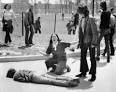 John F. Kennedy's assassination was the beginning of events that changed American society forever, with the advent of the drug culture, riots in large cities across the country and that damnable, divisive Viet Nam War. Four students were killed by skittish National Guardsmen at Kent State University during an anti-war demonstration in 1970. I still contemplate the 10% of the men of my helicopter flight school class who didn't return from Viet Nam. Many members of my generation carry still-festering wounds from that time in their lives.
VIEW THIS CLIP IF YOU WISH
Here's a short, grainy not-quite-six-minute video clip of Walter Cronkite, often described as "the most trusted man in television", delivering the news of Kennedy's death. It was a sad day for this country...
Labels: John F. Kennedy, Lyndon Johnson, Viet Nam
posted by The Pot Stirrer at 11/22/2013 03:11:00 AM
4 comments


